Flying Bulls at EAA AirVenture Oshkosh 2026
Flying Bulls at EAA AirVenture Oshkosh 2026: Two Restored Warbirds, One Formation Pass
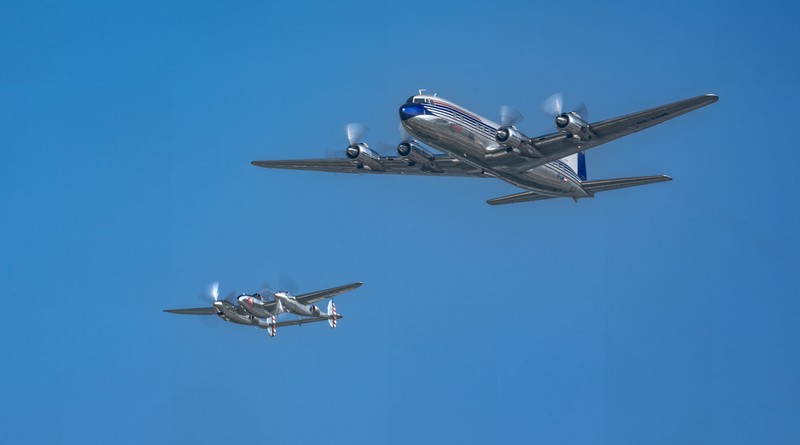
The Flying Bulls' DC-6B and P-38 Lightning on their formation pass, opening day of AirVenture 2026. Photo by Branden Bodendorfer.
I was out on the flight line at Wittman Regional Airport on opening day when the Flying Bulls came around for their pass, and I stopped shooting for a second just to watch. Two airplanes, polished to a mirror, holding tight formation against a clean Wisconsin sky. A four-engine Douglas DC-6B up high, a twin-boom P-38 Lightning tucked in below and behind it. That is the frame at the top of this post. The Flying Bulls at EAA AirVenture Oshkosh 2026 are the reason I made sure I was there on day one and not day five.
Here is why it mattered. For the first time in the team's history, the Flying Bulls crossed the Atlantic to get here, and Oshkosh is their only U.S. airshow stop all year. So this post is two things at once: the story of these two airplanes and the people who brought them back, and a practical guide to photographing them if you are heading to the show later in the week.
🐂 Who Are the Flying Bulls?
The Flying Bulls are a historic-aircraft team based in Salzburg, Austria, out of a glass hangar called Hangar-7. The collection started with one airplane a pilot named Sigi Angerer refused to let disappear, grew from there, and was formalized as The Flying Bulls in 1999 with backing from Red Bull. Today the fleet runs past 40 aircraft, everything from World War II fighters to modern helicopters.
I'll be straight with you. I don't drink the stuff. Never have, probably never will. But standing there looking at what they poured into keeping these two particular airplanes flying, decades of money, hours, and stubbornness that most owners would never sign up for, I walked away with real respect for the operation. You don't fake that kind of commitment. It shows up in the metal.
🛩️ The Two Airplanes
Two aircraft made the trip, and they could not be more different. One is a big polished airliner with a strange political past. The other is one of the rarest fighters flying anywhere. Both are catnip for a camera.
The 1958 Douglas DC-6B
The DC-6B is the shiny one up high in my photo, bare polished aluminum with a red and blue cheatline running the length of the fuselage. Its history reads like fiction. It flew for the Yugoslav airline JAT, then became the personal transport of Zambian president Kenneth Kaunda in the 1970s, then got abandoned on an African runway for years. The Flying Bulls rescued it around 2000 and brought it back to flying condition. Four radial engines, and on a bright day that fuselage throws light like a mirror.
The 1944 Lockheed P-38 Lightning
The P-38 is the twin-boom fighter tucked in behind it. This is the airplane German pilots reportedly called the fork-tailed devil, and it is the only airworthy P-38 in Europe. There are only a handful left flying anywhere on earth. That unmistakable double-tail shape is one of the most recognizable silhouettes in aviation, which is exactly why it photographs so well against open sky.
🌊 A First Atlantic Crossing
Getting two vintage airplanes from Salzburg to Oshkosh is not a direct flight. The team staged the crossing in hops, out of Austria and over the United Kingdom, Iceland, Newfoundland, and Canada before reaching Wisconsin. A lot of that routing came down to the P-38. It is a short-legged fighter, not a transport, so the whole plan had to bend around how far it could safely fly between stops.
The DC-6 was built for exactly this kind of long-haul work, so it made sense as the anchor of the crossing. But the team refused to send it across without the fighter alongside. As their CEO Eskil Ambal put it, You never, ever, ever leave your wingman.
That line does a good job of explaining why both airplanes are here and not just the practical one.
📷 How to Photograph the Flying Bulls at Oshkosh
If you are going later in the week, you get two very different shots at these airplanes, and they call for two different approaches. Plan for both.
On Boeing Plaza (static, up close)
During the day the aircraft sit on Boeing Plaza where you can walk right up to them. Get there early. Morning light is softer and the crowds are thinner, and by mid-afternoon you are fighting harsh overhead sun and a wall of other people's phones. Shoot the details: the reflection of the ramp in the DC-6B's belly, the nose, the engine cowlings, the twin booms of the P-38 framed against the sky. A wide lens gets you the whole airplane in tight quarters. A longer lens isolates the good stuff.
During the afternoon air show (in the air)
This is where most people get it wrong. Your instinct is to freeze the action with a fast shutter, but crank it to 1/2000 and the propellers stop dead, which makes a flying warbird look like a plastic model hanging on a string. Slow down instead.
- Shutter speed: roughly 1/160 to 1/320 for prop aircraft. That keeps the propeller discs blurred so the airplane reads as alive and moving.
- Focus: continuous autofocus (AF-C or AI Servo), and pan with the airplane instead of stabbing at the shutter.
- Practice the pan: plant your feet, rotate from the hips, and keep tracking through the shutter press. Your keeper rate at 1/200 will be lower than at 1/2000, so shoot more frames.
- Sun at your back: the afternoon show puts the light behind the crowd for a good chunk of the passes, which is what you want on polished metal.
📸 The Rare Three-P-38 Possibility
Here is a bonus for anyone chasing warbirds with a long lens. Ahead of the show there was talk that as many as three P-38 Lightnings could end up at Oshkosh 2026 at the same time. I want to be clear that this was reported as a possibility, not a confirmed act, so treat it as a maybe rather than a promise. But think about the math. Only a small number of P-38s are still airworthy on the entire planet. Three of them parked together, or better yet in the air together, would be a genuinely rare frame and worth planning your day around if it comes together.
🗺️ Things to Do Nearby
If you are making the drive to Oshkosh, and for most of Central Wisconsin that is only about an hour to ninety minutes south, build in a little more than the flight line.
- EAA Aviation Museum: on the AirVenture grounds, worth an hour when the sun gets too harsh for good photos outside.
- Downtown Oshkosh and the Fox River: a change of pace and a place to eat that is not a food truck line.
- Lake Winnebago: good evening light off the water once the show wraps.
- More of my photography work here on WiscoLens, including other aviation and Wisconsin shoots.
- Planning a bigger trip around the state? Browse our Wisconsin travel and photography posts and the rest of the featured stories.
❓ Frequently Asked Questions
Is this really the Flying Bulls' first time in the United States?
Yes. AirVenture Oshkosh 2026 is the first time the Austrian team has crossed the Atlantic and flown its aircraft at a public U.S. airshow, and it is their only U.S. airshow appearance of the year.
Which aircraft did the Flying Bulls bring to Oshkosh 2026?
A 1944 Lockheed P-38 Lightning, the only airworthy P-38 in Europe, and a 1958 Douglas DC-6B with a history of carrying heads of state. Both were rescued and restored by the team.
Where is the best place to photograph the Flying Bulls at Oshkosh?
Boeing Plaza early in the morning for close-up static shots, and the flight line along the show center fence for the afternoon air show. Morning light works best on the polished aluminum.
What camera settings work for a propeller airshow?
Drop your shutter speed to roughly 1/160 to 1/320 so the propellers blur into full discs, use continuous autofocus, and pan with the aircraft. Freezing the props at 1/2000 makes a warbird look dead in the air.
When does the EAA AirVenture air show run each day?
The main air show runs in the afternoon each day of the convention, July 20 to 26, 2026, at Wittman Regional Airport in Oshkosh. Check the daily EAA schedule for exact performer times.
💬 Final Thoughts
I came for the airplanes and left thinking about the people. Anybody can buy an old warbird. Very few will spend the years and the money it takes to make one fly again, let alone two, and then fly them across an ocean just so a crowd in Wisconsin can look up and see them. That is what stuck with me. Not the branding on the tail. The fact that these two machines are alive at all.
If you have any pull toward aviation, or you just like pointing a camera at something that moves, go find them on the flight line before the week is out. I'll be posting more frames from the show, so check back.